Perfyra
Shopify Store Launch in 7 Days for the UAE Market
Fast Shopify Launch, Salla Migration, and GCC Payment Setup for Middle East Growth
1500+
Products migrated
7 Days
End-to-end launch
3+
Payment methods live
GCC Ready
Shipping & checkout
perfyra.comAdvibe Team
Problem
Perfyra had to go live in 7 days while handling 1,500+ SKUs, messy product data from Salla, and regional checkout and shipping requirements. Without a clean operational setup, marketing campaigns would be delayed and early conversion would suffer.
Approach
We delivered a non-headless Shopify OS 2.0 build with structured SKU migration from Salla, regional payment and shipping integrations, Saudi shortcode support at checkout, and campaign-ready collection and landing page setup so the team could launch marketing immediately after go-live.
Perfyra needed to get to market fast. They had more than 1,500 products, a tight 7-day timeline, and a storefront still running on Salla a solid platform for the Arabic-first market but not built for the global app ecosystem that Shopify provides. The product catalog was in Arabic, the payment methods had to include Tabby and Tamara alongside card gateways, and shipping needed to work for both UAE buyers and cross-border Saudi deliveries from day one. Marketing campaigns were planned, but the store foundation was not launch-ready.
Live site: perfyra.com
The Challenge
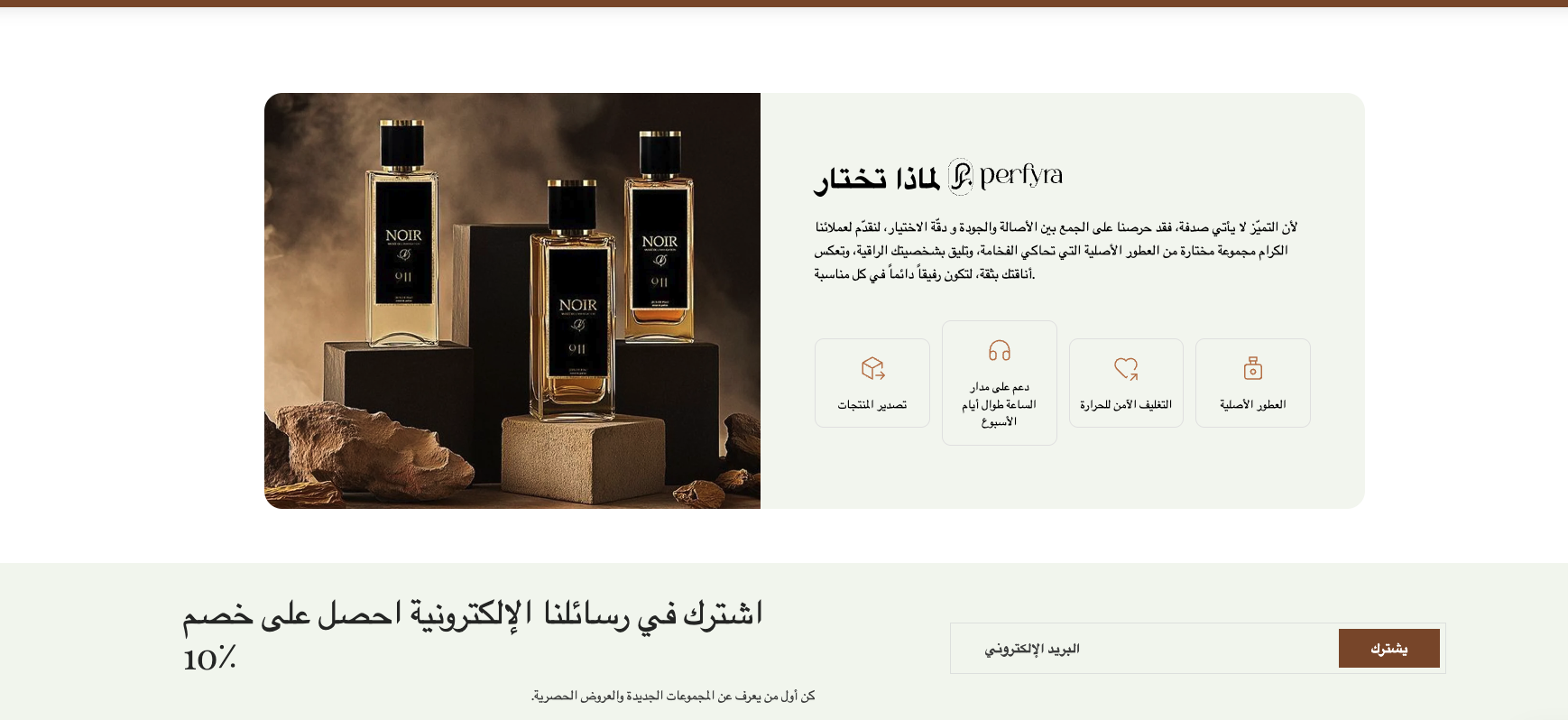
The 7-day countdown started when Perfyra handed over their Salla export. The data was messy. Salla and Shopify treat product data differently variant mapping, metafields, and collection structures do not translate one-to-one. We had 1,500+ SKUs to move, each with Arabic titles that had to be preserved as-is. No machine translation, no transliteration. The exact Arabic product names from the original catalog had to appear on the new storefront.
The timeline was unforgiving. A standard Shopify build for a catalog this size would take two to three weeks. We had seven days. Day one was migration planning and export audit. Day two was Shopify architecture theme selection, app stack, and data schema. Day three was supposed to be payment integration. Day four was shipping configuration. Days five through seven were QA, collection building, and campaign setup. Every day had a dependency on the one before it. One slip would cascade.
The regional requirements added complexity. Tabby and Tamara are not plug-and-play in every Shopify region. They require merchant account verification, specific app configurations, and in Tamara's case manual webhook setup. Shipping was another layer: Aramex for UAE deliveries, SMSA for Saudi cross-border, each with carrier-calculated rates that had to map to correct weight and zone configurations. Saudi shortcode support at checkout was non-negotiable for conversion.
I have built Shopify stores for the GCC market before, so I knew the contours of the work. But knowing the contours and executing on a 7-day calendar are different things.
What We Did
The migration was the critical path. We exported Perfyra's full product catalog from Salla as CSV and wrote a custom data transformation script to handle variant mapping across all 1,500 SKUs. The script matched Salla's variant structure size, color, and bundle configurations to Shopify's variant model, which uses a flat option pattern. Every Arabic product name was preserved in the CSV using UTF-8 encoding. We did not translate a single title.
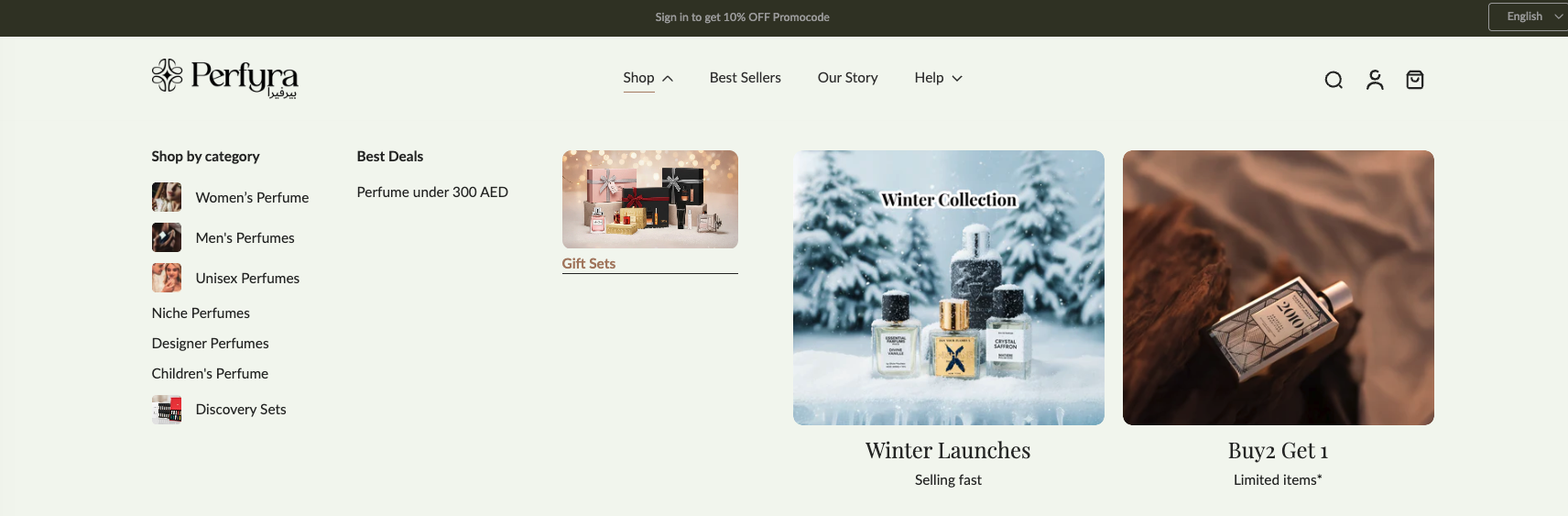
I built the storefront on Shopify OS 2.0 using a premium theme with custom Liquid modifications. The theme handled product display, collection pages, and the cart drawer. The checkout flow used Shopify's native checkout with Stripe as the primary card gateway. Tabby and Tamara were installed as Shopify apps and configured at the checkout level. Tamara required manual webhook mapping for order status updates a step that is easy to miss if you have not set it up before.
Shipping was configured through carrier-calculated apps for Aramex and SMSA. Each courier required API credentials and zone-specific rate tables. For Saudi-bound orders from the UAE warehouse, SMSA rates had to account for cross-border customs handling and dimensional weight. COD was mapped to Saudi shipping zones as a separate payment method.
The last two days were QA and campaign preparation. We spot-checked product data across all variant types simple products, multi-variant products, and bundle-style listings. Collections were organized around product categories and planned campaign segments. We used ChatGPT image generation to produce product and campaign creative assets, which let the marketing team start testing ad creative within hours of go-live instead of waiting days for a design cycle.
Results
Perfyra went live on day seven. The store had clean SKU operations, reliable checkout and shipping for GCC buyers, and a campaign-ready storefront. The marketing team launched their first campaign within 48 hours of go-live. A 7-day launch timeline for a 1,500-SKU store with Salla migration, an Arabic catalog, and GCC payment configuration is at the edge of what is achievable. It requires a team that has done regional Shopify builds before and a client who moves fast on decisions.
What We Learned
We underestimated the product data quality issue from the Salla migration. When we pulled the full export, 340 products had missing or incorrect variant data size options with no associated inventory, product images referenced in the data but absent from the file, and variant prices that defaulted to zero. Day 3 of the 7-day timeline was supposed to be payment integration setup. Instead, day 3 became entirely data cleaning.
The lesson is not that Salla exports are bad it is that every migration, regardless of source platform, requires a data audit before the timeline is quoted. We now run a mandatory data audit on every catalog migration before committing to a launch date. If we had done this before the Perfyra engagement, I would have quoted 9 days instead of 7 and had margin for the data work. The 7-day delivery still happened but day 3 was not what we planned.
GCC-Specific Integration Details
Salla is the dominant Arabic-first e-commerce platform in Saudi Arabia, and many GCC merchants we work with are migrating from it to Shopify for better app ecosystem support and international scalability. As of 2026, there is no official Salla-to-Shopify migration tool. Every migration is a manual or scripted process. The key difference between platforms is variant data structure: Salla uses a relational product model while Shopify uses a flat option system. Arabic product data requires UTF-8 CSV handling to avoid encoding loss during import.
Tabby and Tamara are the two most requested buy-now-pay-later providers in the GCC. Both require merchant account verification before Shopify app installation. Tabby's Shopify app integrates at checkout with minimal configuration. Tamara requires manual webhook mapping for order status synchronization a step that Apple Pay and Stripe integrations do not need. If you are setting up Tamara for the first time, budget an extra half-day for webhook testing.
For shipping, Aramex and SMSA are the standard couriers for UAE-to-GCC e-commerce. Both are configured via carrier-calculated shipping apps that connect to the courier's API for real-time rate calculation. SMSA is particularly important for KSA deliveries originating from a UAE warehouse, as Saudi customs documentation and dimensional weight calculations differ from domestic UAE shipping.
For a deeper walkthrough of Shopify setup for Middle East markets, see the Shopify Development Guide. For context on how this UAE launch fits into a broader CRO strategy, see Shopify CRO in Dubai.
Project in motion
Outcome
Perfyra went live in 7 days with clean SKU operations, reliable checkout and shipping for GCC buyers, and a campaign-ready storefront that allowed the team to start marketing on schedule.
FAQ
FAQ
How long does it take to migrate from Salla to Shopify?
Under 500 products typically takes 3 to 5 days. For 1,000 to 2,000 products, expect 7 to 10 days. Data quality is the biggest variable a clean export can save multiple days of cleaning work. Always run a data audit before quoting a timeline.
Does Shopify support UAE shipping carriers?
Yes. Aramex and SMSA can both be integrated via carrier-calculated shipping apps available in the Shopify App Store. COD can be configured as a separate payment method and mapped to specific shipping zones, which is the standard setup for Saudi deliveries.
Can Shopify handle Arabic product catalogs?
Yes. Shopify supports Arabic RTL text natively at the theme level. Product data imports correctly when the CSV is UTF-8 encoded, and Arabic product names, descriptions, and metafields display without encoding issues.